When Walking Away Is an Act of Self-Respect, Not Selfishness
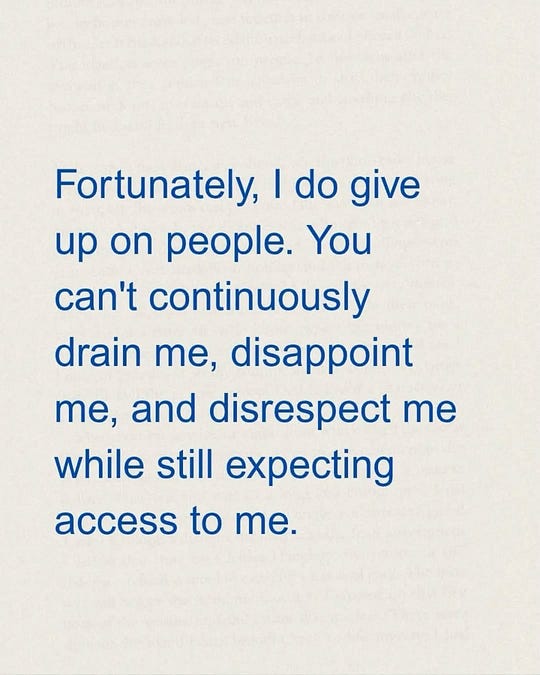
“Fortunately, I do give up on people. You can’t continuously drain me, disappoint me, and disrespect me while still expecting access to me.”
At first glance, this statement may sound harsh. In a world that glorifies unconditional loyalty and endless patience, choosing to walk away is often misunderstood as giving up too easily. But there is an important distinction between giving up on someone and protecting your own mental well-being.
There comes a point where constantly trying to save a relationship begins to cost you your peace. Whether it’s a friendship, a romantic relationship, a family bond, or even a professional connection, no relationship should require you to sacrifice your self-worth.
The Difference Between Patience and Self-Neglect
Healthy relationships require effort, forgiveness, and understanding. We all make mistakes, and no one is perfect. However, repeated disrespect, emotional manipulation, broken trust, or constant disappointment are not signs of a healthy relationship – they are warning signs.
Many people stay because they hope things will change. They convince themselves that if they love harder, communicate better, or become more understanding, everything will improve. Sometimes it does. But when only one person is carrying the emotional weight, the relationship slowly becomes exhausting rather than fulfilling.
Patience should never mean tolerating repeated harm.
Protecting Your Energy Is Healthy
Mental health is deeply connected to the people we surround ourselves with. Constant criticism, emotional neglect, disrespect, or one-sided relationships can slowly drain our confidence and emotional resilience.
When you are continuously giving while receiving hurt in return, your mind begins to normalize stress. You become anxious before conversations, overthink every interaction, and question your own worth.
Protecting your emotional energy isn’t selfish. It’s necessary.
Just as we set boundaries around our physical health, we must also set boundaries around our emotional health.
Boundaries Are Not Punishment
One of the biggest misconceptions about boundaries is that they are meant to hurt others.
They’re not.
Boundaries simply communicate:
- “I deserve respect.”
- * “My peace matters too.”
- * “I will no longer participate in relationships that consistently harm me.”
People who benefited from having unlimited access to your time, kindness, and emotional support may not appreciate your boundaries. That doesn’t mean your boundaries are wrong.
It simply means the relationship was built without respecting them.
Giving Up Isn’t Always Failure
Society often tells us to never give up on people.
But perhaps the healthier message is this:
Don’t give up after one disagreement.
Don’t give up because someone made a mistake.
Don’t give up because relationships require effort.
But do walk away when the pattern becomes clear – when apologies never turn into change, when respect is replaced with entitlement, and when your kindness is repeatedly taken for granted.
Sometimes, walking away isn’t giving up on someone.
It’s choosing not to give up on yourself.
A Lesson for Mental Health
As mental health professionals, educators, and individuals, we often encourage compassion toward others. Yet we sometimes forget to extend that same compassion to ourselves.
Healing doesn’t always mean fixing every relationship.
Sometimes healing means accepting that not everyone is meant to stay in your life forever.
Some people teach us love.
Some teach us resilience.
Some teach us boundaries.
Every relationship has a purpose – even the ones that end.
Final Thought
The healthiest relationships don’t make you question your worth. They don’t leave you emotionally drained after every interaction. They challenge you to grow while making you feel respected, valued, and emotionally safe.
Walking away from repeated disrespect isn’t an act of anger.
It’s an act of self-respect.
Because people are not entitled to unlimited access to you simply because they know you. Access is earned through mutual respect, trust, kindness, and care.
And protecting your peace is one of the healthiest decisions you can make – for yourself and for your mental well-being.